
AI Writes It. AI Reads It. So Who Is It For?
More and more of what we write is written by AI, and more and more of what we read is summarized by AI. Somewhere in the middle, people are disappearing.
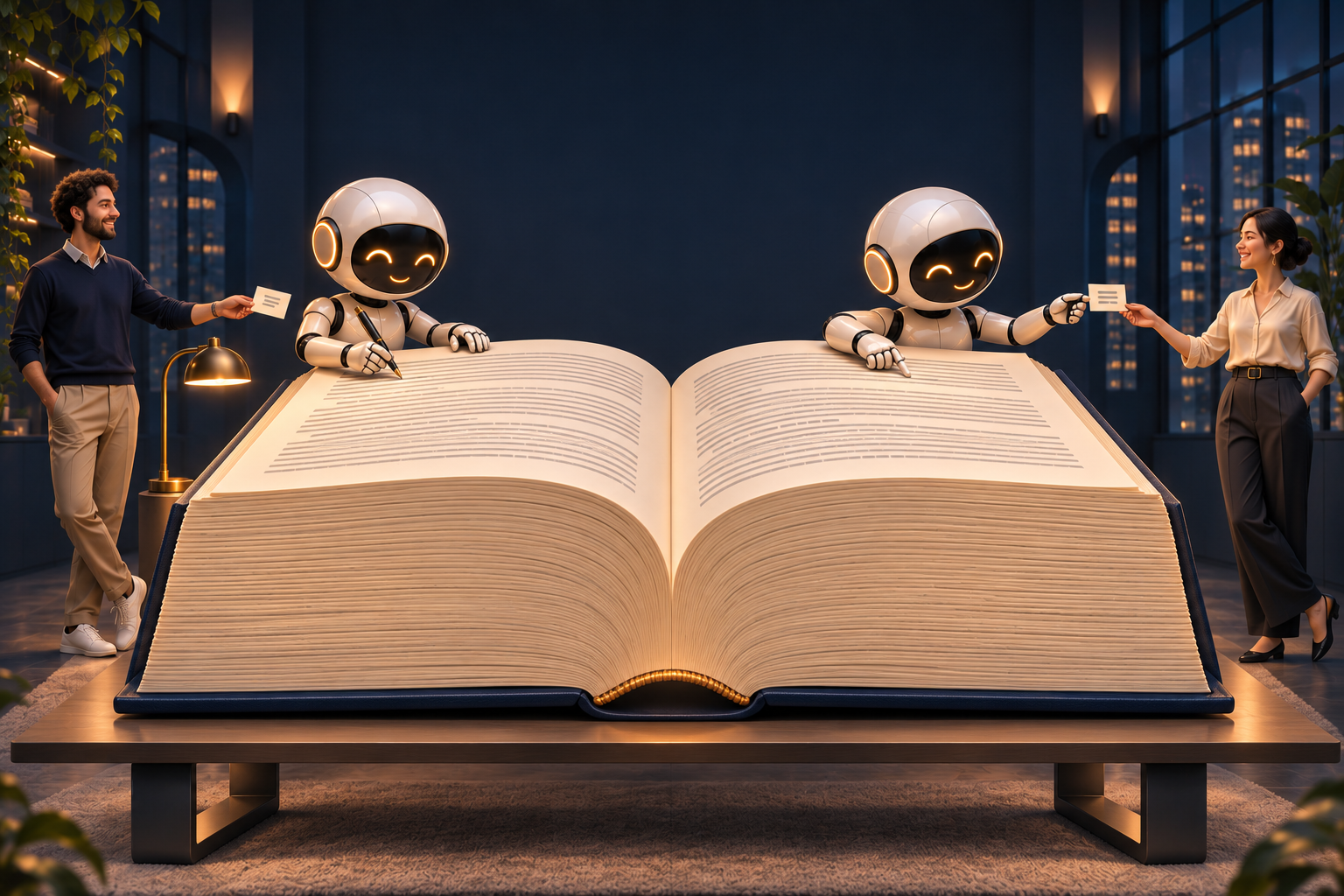
Here is a conversation that probably happened thousands of times today.
Someone asks AI to write a long, polished email.
The person who receives it asks AI to summarize it.
Then they ask AI to write the reply.
And on the other side, the first person asks AI to summarize that.
Two people. Four AI tools. One conversation.
And it's not clear that anyone actually read anything.
The loop is already here
This isn't only about email.
Earlier this year, Pangram analyzed more than a million social media posts. About 41% of long LinkedIn posts looked fully written by AI. Some other estimates put it even higher.
On the reading side, summarizing is now one of the most common ways people use AI at work. In a ZipRecruiter survey this fall, about 4 in 10 workers using AI said they use it to summarize documents and meetings. And some people now delete an email after reading only the AI summary.
Put the two together, and you get a strange loop:
Machines write for machines, and people skim what's left.
What gets lost in the middle
Writing used to be a form of thinking. To write something clearly, you had to understand it first.
When AI writes it for us, that thinking can quietly disappear. The text still looks good. It just doesn't always mean much.
There is now a name for this: "workslop." Work that looks finished, but isn't. In a study published this February, more than half of American office workers admitted they had sent AI-generated work like that. The people on the receiving end said they lost hours every month fixing it.
Reading changes too. A summary is useful, but it keeps what is common and drops what is unusual. And the unusual part is often the one that mattered: the small doubt, the honest caveat, the sentence that was actually the point.
There is a quieter loss as well. A long, careful message used to be a sign that someone cared. Now length is free.
When words cost nothing, attention becomes the only thing that still means something.
So who is it for?
To be clear, this isn't an argument against AI. It is great for routine messages, first drafts and finding the one thing you need in a long report.
In full honesty, this essay was written with AI's help too. That's how NOA works. But a person decided what was worth saying, and a person read every line before you did.
That's the difference I think we should protect.
A simple rule might be enough:
- If it matters, write it yourself, or at least read every word that goes out under your name.
- If it matters, read the original, not only the summary.
- And if you didn't read it, don't send it.
Because in the end, everything we write is for someone.
Make sure there's still someone there.
See you in a Thoughtful Future.
References
Pangram (2026). Study of AI-generated content across LinkedIn, X, Reddit, Medium and Substack. Coverage:
https://www.techtimes.com/articles/320534/20260715/linkedin-leads-all-platforms-ai-written-posts-study-million-feeds-confirms.htm
Originality.ai (2026). LinkedIn AI-generated posts analysis. Coverage:
https://en.cryptonomist.ch/2026/07/12/ai-content-prevalence-social-media/
ZipRecruiter Economic Research (2026). Better Work, More to Learn: The 2026 AI Worker Report.
https://www.ziprecruiter-research.org/economic-insights-research/2026-ai-worker-report
Validity (2026). Consumer study on AI-generated inbox summaries. Coverage:
https://www.demandgenreport.com/industry-news/news-brief/validity-72-of-marketers-are-adapting-email-strategies-for-ai-generated-inbox-summaries/55090/
PsyArXiv (2026). Survey of American desk workers on AI-generated "workslop."
https://osf.io/preprints/psyarxiv/5f78h_v1